
Criminal Court Cases in Swain County
North Carolina's unified General Court of Justice places both local criminal divisions at the Swain County Courthouse, 101 Mitchell Street in Bryson City. District Court hears misdemeanors, infractions, first appearances, and preliminary felony matters. Superior Court has felony trial jurisdiction and handles felony pleas, trials, sentencing, and later motions. The Clerk of Superior Court keeps both sets of Swain County criminal case records. That single counter avoids the separate county-clerk and district-clerk split found in some states.
The clerk's public hours are 8:30 a.m. to 5:00 p.m. on weekdays, and the main line is 828-488-7400. Magistrates can be reached at 828-488-7419, while the District Attorney's Swain line is 828-488-7410. A person asking about a case should bring the case number, party name, filing year, and document title when known. The official courthouse page also confirms wheelchair access.
The Judicial Branch courthouse profile shows the building and its official visitor details.
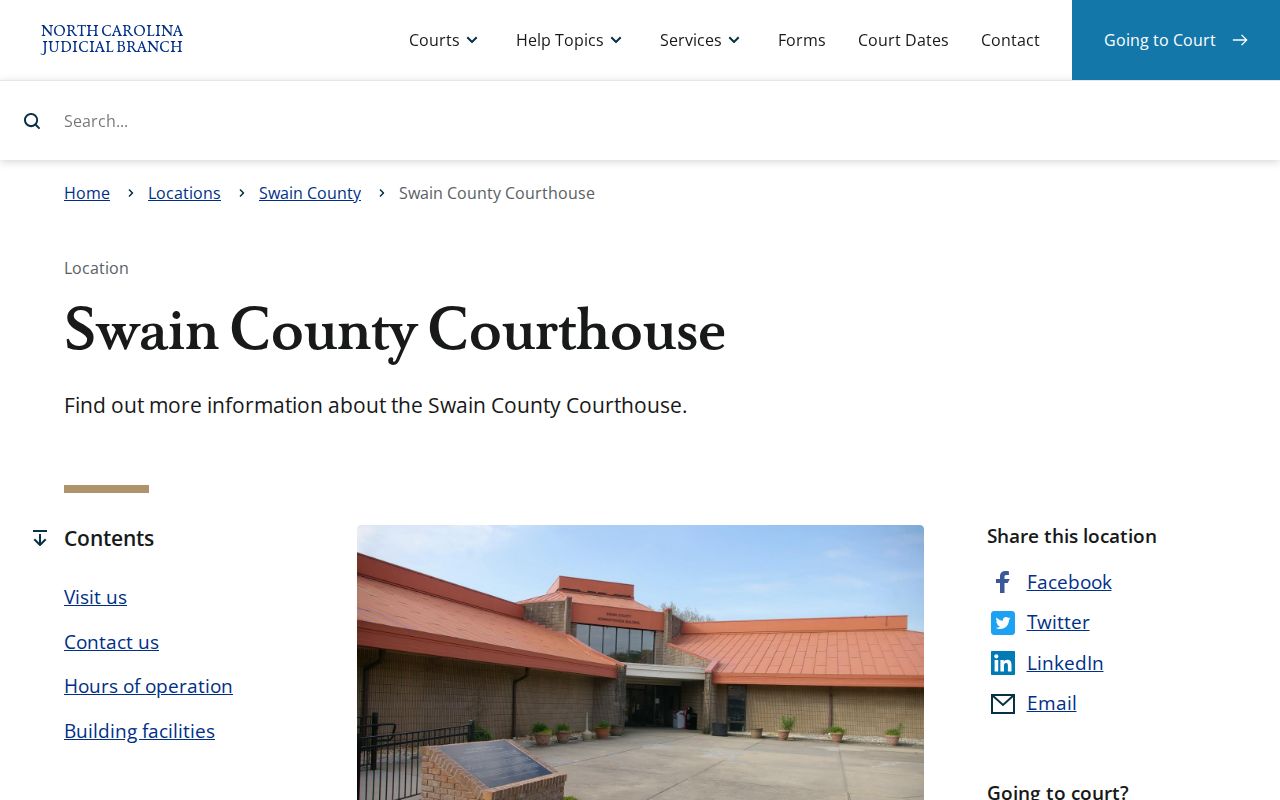
This courthouse is the local source for a file that needs inspection, retrieval, copying, or certification.
Swain County Court Divisions
The division name matters because one criminal matter can move between courts. A felony defendant may first appear before a magistrate and have preliminary proceedings in District Court before the case reaches Superior Court. A misdemeanor generally remains in District Court. Bryson City has no municipal criminal court, so town ordinance and misdemeanor prosecutions also enter the state system at the Swain courthouse.
One phone directory covers several parts of that system. The official Swain court directory lists the clerk, judges, prosecutor, and magistrate contacts.
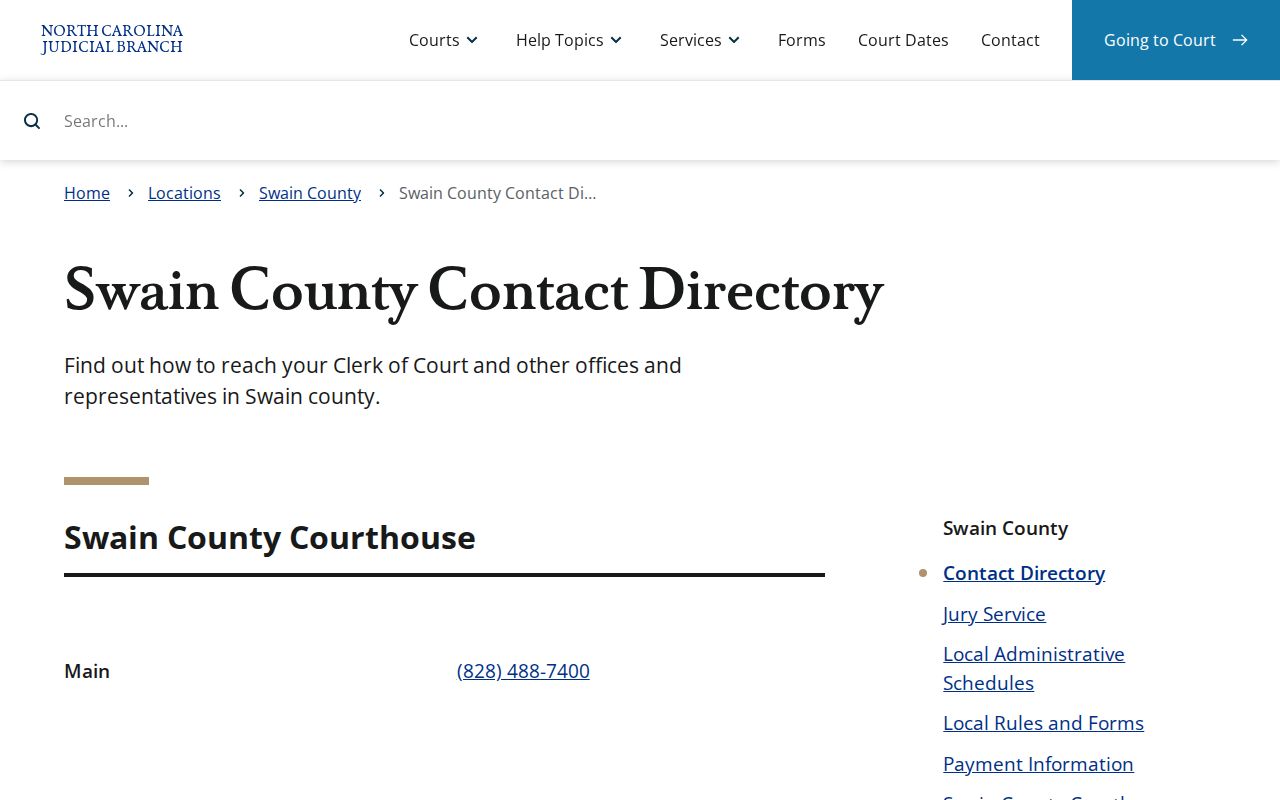
The directory helps route a records question without confusing the clerk's custody role with the prosecutor's work on a charge.
| Court or office | Criminal role | Contact |
|---|---|---|
| Superior Court | Felony pleas, trials, sentencing, and post-judgment matters | Clerk 828-488-7400; judges 828-369-7299 |
| District Court | Misdemeanors, infractions, and early felony matters | Clerk 828-488-7400; judges 828-454-6511 |
| Magistrates | Initial process, appearances, and release functions within authority | 828-488-7419 |
Swain County Case Record Searches
The North Carolina eCourts Portal is the main remote channel. All 100 counties use Enterprise Justice, so Smart Search includes Swain County cases. Ordinary public searches are free and do not require a login. Exact case numbers work best. A name search should be narrowed to Swain County, Criminal Actions, status, and a filing-date range to reduce same-name results.
- Open Smart Search and enter a party name, record number, citation number, or another supported key.
- Select Swain County under Location and Criminal Actions under Case Type.
- Add date of birth, status, or filing dates when the available facts support those filters.
- Open the Case Summary and read charges, events, hearings, dispositions, judgment, and financial entries in context.
- Give the clerk the case number and document title when a certified or non-imaged record is needed.
Do not rely on the portal alone when identity or certification is central. Any North Carolina courthouse public terminal allows a free noncertified countywide or statewide court search. A certified Swain-only name search uses form AOC-CR-314 and costs $25. The Judicial Branch record-search page compares these official choices.
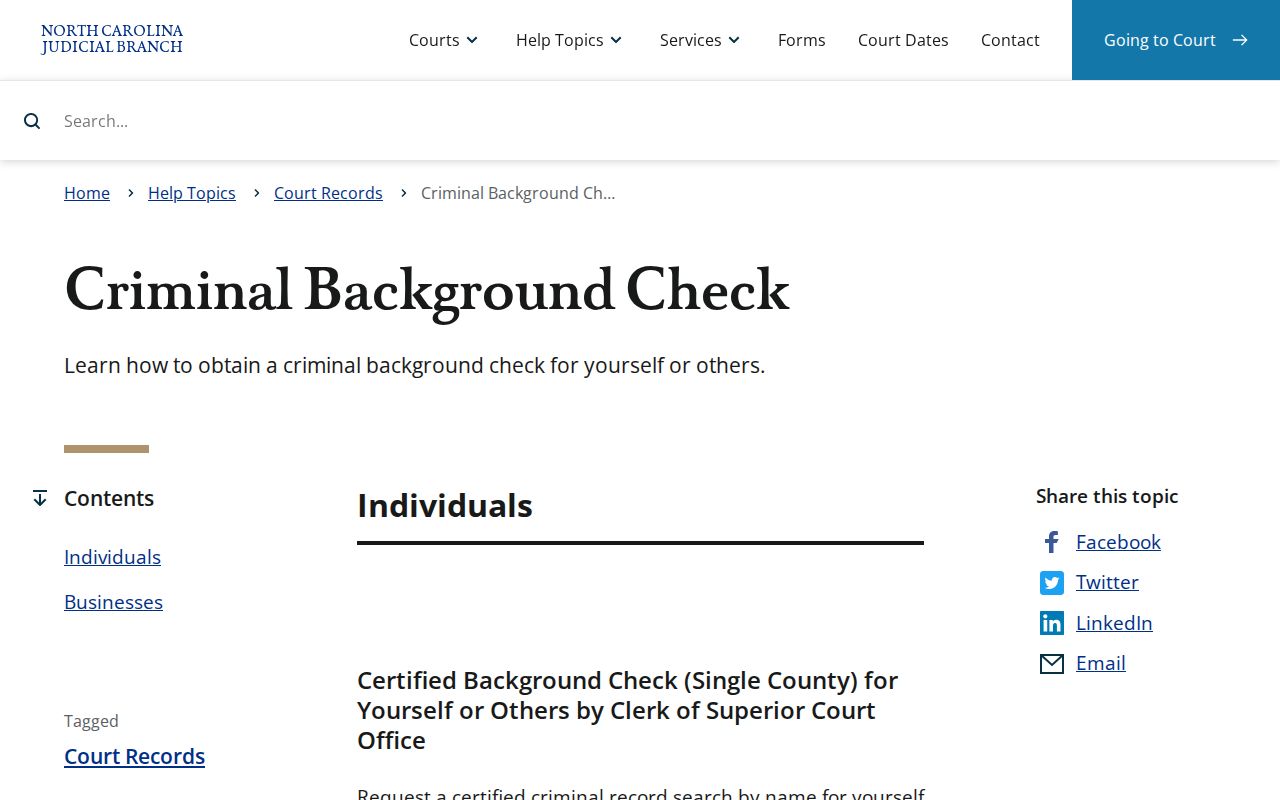
The comparison makes clear that online viewing, a courthouse terminal search, and a certified clerk result are distinct products.
Swain eCourts Case Filters
Official wildcard rules can help with uncertain spelling. Use at least three last-name characters followed by an asterisk, and at least one first-name character followed by an asterisk. A partial case-number search needs at least four characters and an asterisk. Swain criminal case numbers follow an Enterprise Justice pattern with a two-digit year, case-type letters, a six-digit sequence, and a three-digit county identifier.
The official Portal training material explains Smart Search, hearings, judgments, filters, and payment tools.
Those instructions are useful when a broad party search returns too many statewide results or hides the needed Swain County docket.
| Field label | Type | Required | Use |
|---|---|---|---|
| Smart Search input | Text | Yes | Name, case number, citation, business, attorney, or cross-reference |
| Location | Selection | No | Select Swain County to limit same-name results |
| Date of Birth | Date | No | Narrows party matches when available |
| Case Type | Selection | No | Choose Criminal Actions |
| Case Status | Selection | No | Narrow pending or disposed matters |
| Filing Date | Date range | No | Limits the filing window |
| Search Hearings | Tab | No | Checks scheduled time, place, and judicial officer |
What a Criminal Case File Contains
A Swain County court case file records the prosecution after charges are filed. It is not the same as the arresting agency's report or the jail intake entry. Portal results can show the case number and style, filing date, court, status, assigned judicial officer, parties, charges, events, hearings, dispositions, judgments, and financial information. Public documents may also be viewable. A field may be absent because it does not apply, has not yet been entered, or is restricted.
| Case Number and Court | Identifies the Swain case, division, and filing record. |
|---|---|
| Charging Record | Shows the charges actually filed, which may differ from booking language. |
| Register of Actions | Lists filed events, continuances, pleas, motions, and other docket activity. |
| Hearing Dates | Shows scheduled proceedings, not proof that each hearing occurred. |
| Disposition and Judgment | Records the outcome of each charge and the court's judgment. |
| Sentence and Finances | May show sentence terms, restitution, costs, and related entries. |
Read each charge line through its own disposition. One count may be dismissed while another ends in a plea or trial judgment. A calendar entry only shows scheduling. It does not prove that a hearing occurred or that the case reached an outcome that day.
Reading Swain County Case Dockets
Several court terms change the meaning of a Swain County case. An arraignment is the proceeding where charges are formally addressed and a plea may be entered. A disposition is the outcome of a charge. A nolle prosequi means the prosecutor chose not to proceed at that time, so the surrounding docket still matters. An acquittal follows a not-guilty finding, while a dismissal ends a charge without a conviction.
Portal's Register of Actions supplies the time line, but the filed judgment is the best source for the final court result. Charges can also change between a jail booking and the prosecutor's filing. A person reviewing a court case should never treat the booking label, first complaint, or indictment as proof of guilt. The judgment and disposition entries answer a different question.
- Disposition
- The recorded outcome of a specific charge.
- Indictment
- A grand jury's formal felony accusation, not a conviction.
- Recognizance
- Release based on a promise and conditions without secured money.
- Criminal calendar
- An official schedule that does not prove the listed hearing took place.
Criminal Case Stages in Swain County
A state prosecution begins when a charge is filed. The accused then reaches an initial appearance and, where required, arraignment. Pretrial work can include discovery, motions, continuances, probable-cause activity, or indictment. The matter may end by dismissal, negotiated plea, or trial. A conviction leads to judgment and sentencing. Later events can include probation action, appeal notices, or a petition tied to record relief.
Case flow: Charges Filed › Arraignment › Pretrial › Plea or Trial › Disposition › Sentencing
The sequence is a reading aid, not a promise that every Swain County docket contains each step. A misdemeanor may take a shorter route. A felony can move from preliminary District Court activity to Superior Court. Portal events should be checked against the actual filed documents when the distinction affects how the outcome is understood.
Swain County Court Calendars
Swain participates in mountain-county schedules rather than a simple weekly local pattern. Superior Court District 43A administrative sessions coordinate Macon and Swain, and District 43 calendars rotate among counties. The live Swain administrative schedules are safer than an old saved date.
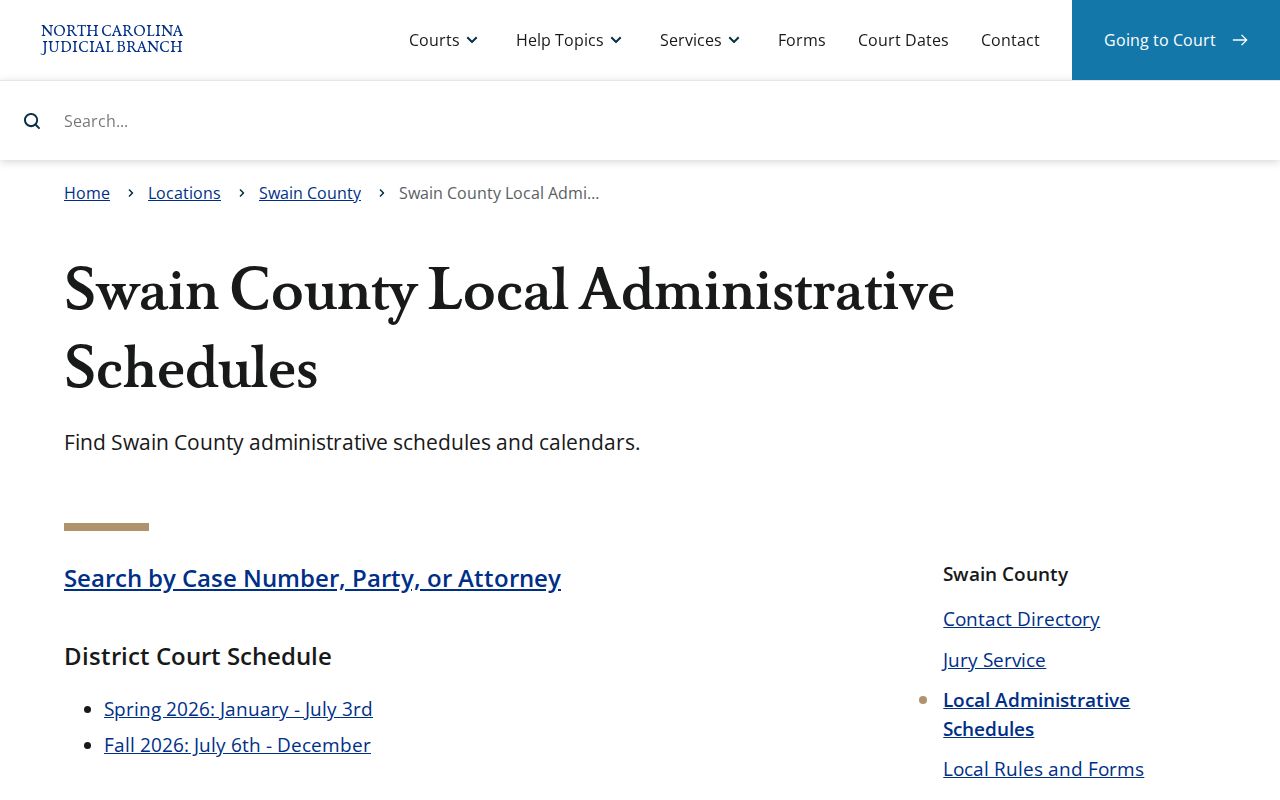
The schedule page helps confirm current sessions, while the individual case docket remains the source for that matter's filed events.
A near-real-time Portal entry can still lag a courtroom action that was just announced. Confirm urgent timing with the clerk. Give the full Swain County case number when calling, and separate a scheduled hearing from the judgment that later records what the court actually did.
Access Rules for Case Records
G.S. 7A-109 directs clerks to keep court records open for inspection, subject to statutes and court orders. Public access does not extend to every item. Sealed cases, juvenile records, confidential identifiers, protected victim or minor information, and some sensitive material can be withheld or redacted. Online access may also be narrower than the file available at the courthouse.
Older or non-imaged Swain County criminal records may require counter retrieval. Ask for a certified copy by naming the case number and the exact judgment or filing. The clerk can quote current copying and certification charges because the research does not establish one flat fee for every document. A separate certified name search costs $25 and covers Swain County court records only.
The Judicial Branch's official expunction form library lists forms keyed to North Carolina law.
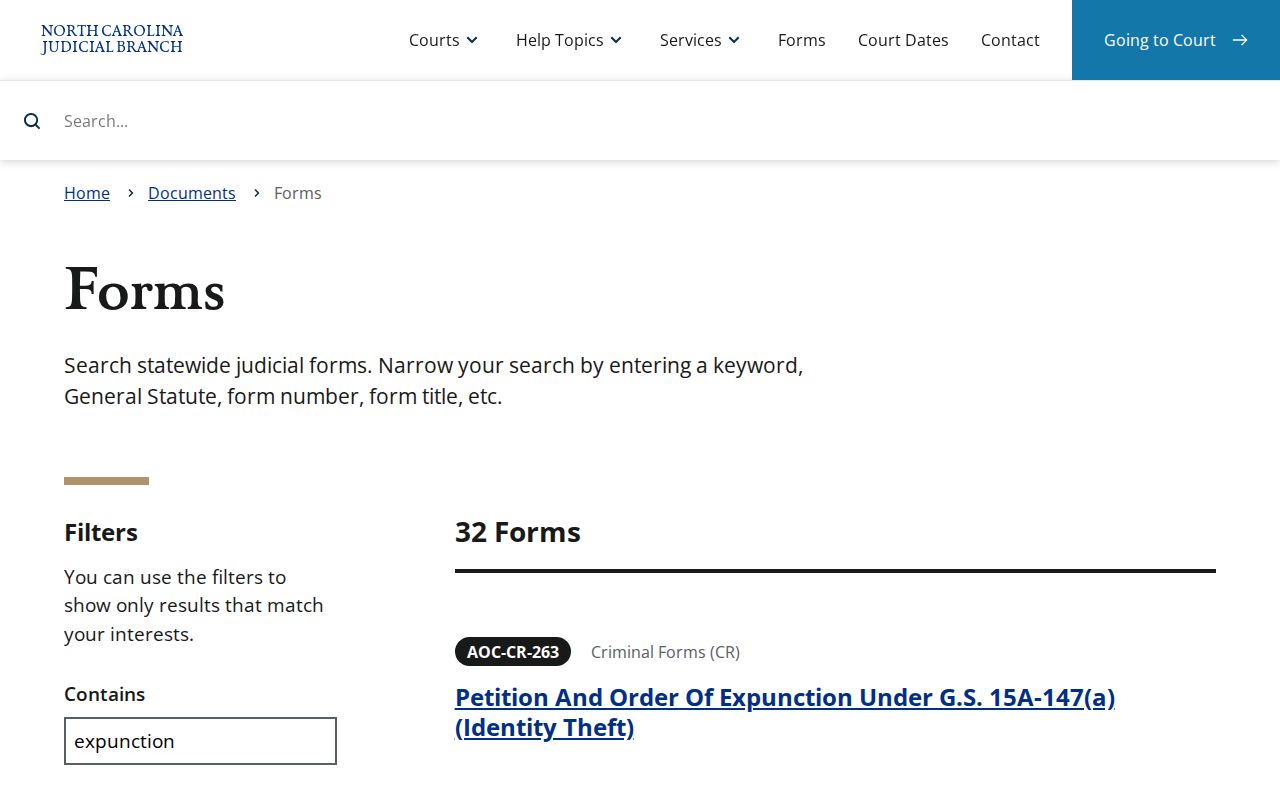
An expunction filing belongs with the clerk where the charge or conviction occurred, and an order can remove qualifying material from ordinary public systems.
Qualla Boundary Case Records
A Swain County address does not always mean the state court file is the full record. The Qualla Boundary spans parts of Swain and Jackson Counties. Depending on the incident location, offense, and Indian status of the parties, Cherokee Indian Police, Cherokee Court, or the federal Western District of North Carolina may hold the relevant file. Qualifying Indian Country cases can proceed under federal jurisdiction.
If no matching Swain County criminal case appears, first confirm which agency made the arrest and where the event occurred. A federal prosecution can be searched through PACER. Tribal records follow the Cherokee channel. This fork is not evidence that a county record is missing. It may show that the search began in the wrong court system.
Note: Match the incident location and creating agency before deciding that a Swain County case search is complete.